
ADU Incentive Program
What is an ADU?
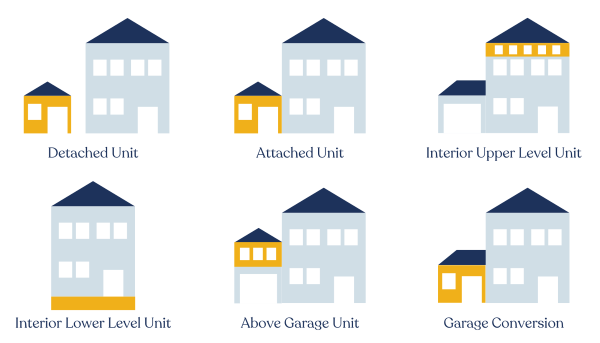
An Accessory Dwelling Unit (ADU) is a self-contained home with a kitchen, bathroom, and bedroom that has a separate entrance from the primary home.
ADUs come in many shapes and sizes. From small studios to larger multi-bedroom homes, ADUs can serve different needs and purposes. Because of that, ADUs provide flexible housing options for families, caregivers, renters, and communities.

ADU Incentive Program
The ADU Incentive Program is a statewide initiative administered by the Massachusetts Housing Partnership (MHP) in collaboration with the Executive Office of Housing and Livable Communities (HLC) to promote ADU construction. The program is designed to help property owners evaluate and advance ADU projects while supporting broader housing goals across Massachusetts.
The ADU Incentive Program will be launched in phases. The first phase will help property owners get started by providing a directory of professional feasibility study providers who have agreed to charge property owners no more than $500 for performing feasibility studies.
Selecting a Feasibility Study Provider
As part of the ADU Program, property owners interested in building an ADU may choose any of the Feasibility Study Providers listed below. Any Massachusetts property on which residential use is allowed may receive one feasibility study under the ADU Program. Property owners select a Provider from the list below and work directly with their chosen Provider throughout the feasibility study process.
Property owners may wish to compare Providers based on factors such as service area, availability, and any potential out-of-pocket costs. Under the ADU Program, Providers may charge property owners up to $500 for a feasibility study. Any fees charged by Providers are noted on the list of eligible Providers below. Property owners are encouraged to conduct their own research and are solely responsible for evaluating and selecting a Provider that meets their needs.
What is a Feasibility Study
Feasibility studies are intended to support a property owner’s early decision-making about building an ADU. A feasibility study includes:
- Information about your property’s unique conditions and constraints
- Local zoning and permitting considerations
- Utility needs (water, sewer, and energy)
- Preliminary design considerations
- High-level cost and budget estimates
MHP does not prescribe a specific format for feasibility studies. As a result, the content, methodology, and formatting of feasibility studies may vary by Provider. If you have any questions about the format of a Provider’s feasibility study, please contact them directly.
Receiving a feasibility study does not obligate a property owner to build an ADU, nor does it obligate a property owner to use the chosen Provider for any additional services.
What's not in the Feasibility Study
- Architectural designs, engineering plans, construction documents, permit applications, or a guarantee that the ADU is constructable.
A feasibility study does not guarantee project approval, permitting, financing, construction, or any other project outcome.
Payment and Cost of Feasibility Studies
The ADU Incentive Program pays $500 directly to the Providers for each complete feasibility study. In return, Providers have agreed not to charge property owners more than $500 for feasibility studies provided under the ADU Incentive Program. You will see the amount Providers charge for feasibility studies in the list below.
Directory of Feasibility Study Providers
This list will be updated regularly through October 30, 2026.
Important Information
As noted above, property owners may wish to compare Providers and conduct their own research in selecting a Provider that meets their needs.
- Inclusion on the list does not constitute a recommendation, endorsement, certification, guarantee, or warranty by MHP of any Provider or of the Provider’s services, work product, performance, results, or costs. Property owners should not rely on a Provider’s inclusion on the list as a substitute for their own evaluation in selecting a professional to perform this work.
- Providers are not employees, agents, representatives, partners, or contractors of MHP. MHP is not a party to any agreement between a Provider and property owner and does not assume any responsibility or liability for any acts, omissions, services, advice, findings, recommendations, work product, schedules, costs, errors, or disputes arising out of or relating to a Provider’s services or a property owner’s engagement of a Provider.
- To anonymously report any ethical or compliance concerns to MHP, you may use any of the following methods:
- Computer or laptop
- Mobile devices
- Phone: 833-280-2861
ADU FAQs
Where can I learn more about building an ADU in Massachusetts?
- Check out the Massachusetts ADU Resource Center. Here you’ll find comprehensive information including the ADU Wizard to inspire, guide and help you build your ADU.
- You can learn more about the new ADU law and regulations at mass.gov/adu.
How can I finance my ADU?
- Contact your local bank or lending office for information or to see if you qualify for MassHousing’s ADU Loan Program. To be alerted to future ADU incentive programs, if additional funding becomes available please fill out the contact form below.
- For rough guidance on what you might be able to afford, use the Massachusetts ADU Resource Center Financial Calculator.
Where can I find ADU designs?
- Find free, downloadable ADU designs at the Massachusetts ADU Design Challenge Showcase.
- Explore the ADU Floorplans gallery at the Massachusetts ADU Resource Center.
What are the steps for building an ADU?
- The Massachusetts ADU Resource Center provides a guide to the steps you’ll need to take to build an ADU. You’ll also find answers to the most frequently asked questions during each step.
What are my community’s local ADU rules and regulations?
- Contact your local building or planning department for questions about local ADU rules and regulations. You can find the ADU regulations at mass.gov/adu.
How were Providers placed on the list?
- Providers on the list were selected through a competitive Request for Qualifications (RFQ) process and demonstrated that they met the minimum qualifications established under the ADU Program. Inclusion on the list means only that a Provider met those minimum qualifications at the time of selection.
Are there specific resources for people who live in the Pioneer Valley?
Homeowners in the Pioneer Valley can take advantage of the Pioneer Valley ADU Accelerator. The Accelerator provides hands-on technical assistance to homeowners in Franklin, Hampden and Hampshire Counties interested in building detached, all-electric, energy-efficient modular or panelized ADUs. The Accelerator can help homeowners better understand their property, compare options, navigate early project decisions, and determine appropriate next steps.
Contact
Subscribe to our mailing list to be notified of future ADU Program updates.
Still have questions? Fill out this form.